Author: Davrielle Peters

  • Behind Anger

    Behind Anger

    Anger is a word that mainly depicts negativity and poor behavior. However, it is an ordinary human emotion that we all experience on various occasions. Sometimes, this helpful reaction allows us to express opposition or detestation toward someone or something that may have wronged us. 

    In some cases, it’s more than just expected or natural anger. Some anger issues have a deeper story behind them that many people may be unaware of. Although people tend to assume the worst when faced with displays of anger, they may not be aware of what is happening or has happened behind the scenes.

    Not all anger is unhealthy anger. It can be healthy or acceptable if it’s not causing harm, becoming a go-to reaction, or damaging relationships and friendships.

    The Common Causes Of Anger.

    Some people are triggered easily due to traumatic events from their childhood, past, or even current experiences. Others can get angry because of feeling slighted. Due to the situation and its intensity, different types of anger will surface, leaving you experiencing either minor irritation to full-blown rage.

    The common causes of anger include:
    • Fear or hurt
    • Stressful situations
    • Feeling attacked
    • Mental health conditions
    • Being disrespected
    • Past trauma and abuse
    • Neglect or abandonment, etc.

    These factors and many others can cause an outburst or constant anger due to struggling to regulate emotions. So not everyone we see who displays some form of anger is just angry for no reason.

    How To Deal With Anger Issues?

    Recognizing The Warning Signs.

    Recognizing when you’re about to feel angry, you’ll be in an excellent place to implement some of the tips listed below before you lash out or get out of control.

    Some of the warning signs are:

    • Pounding heart
    • Gritting your teeth
    • Sweating
    • Tight chest
    • Shaking
    • Feeling anxious
    • Raising your voice
    • Being snappy or defensive
    • Temporarily losing your sense of humor
    • Pacing
    • Getting a ‘flash’ of a bad mood
    • Being overly critical of someone
    • Feeling argumentative

    Try To Figure Out Why You’re Angry.

    There are various reasons why you might be angry. It’s normal and understandable in some situations, for instance, when you or someone else is unfairly or poorly treated. 

    Some other reasons you might be feeling angry are that you’re under a lot of pressure, experiencing bodily or hormonal changes that cause mood swings, or you’re frustrated with the present stage of your life.

    Determining why you’re angry will be easier to manage and prevent you from jeopardizing relationships and the stability of your mental health and well-being.

    Take Some Time Out To Relax.

    Knowing what helps you relax can be very useful whenever you’re feeling the symptoms of anger. Taking time out to do something you enjoy makes a big difference in any hostile situation. 

    You can try activities like walking in the park, reading a book, meditating, listening to music, or relaxing apps like SoulSpace.

    Talk To Someone.

    Talking to someone you trust about how you feel and what you’re experiencing can take a weight off your shoulders and your mind—a trusted adult, friend, or family member. However, if your anger persists and negatively impacts your daily life and relationships, it is time to seek a professional. 

    Conclusion

    We as individuals must be mindful and aware of what a person may be going through. For example, if we are victims of someone’s anger, we should try to understand them or their situation before concluding that they are bad and treating them likewise. Your kindness and understanding can bring them out of a negative place and bring peace and happiness.

    If you have been experiencing issues with anger, click here to try our free trial of the Chrisitan Meditation App, Soulspace.

    Visit us today at https://evolvinu.com to find out more about us and our Online Therapy services. Embrace your metamorphosis! 
    References:
    https://au.reachout.com/articles/8-ways-to-deal-with-anger
    https://www.talkspace.com/blog/what-causes-anger/
  • Conflict Resolution

    Conflict Resolution

    Conflict resolution is a helpful tool that we can use to resolve ongoing issues that relationships or families may have. It’s ok not to agree on various things, but we must be mature enough to handle situations the right way.

    Since conflict is a part of being human, effective conflict resolution is a measure taken to end a dispute and reach an agreement that satisfies all parties involved.

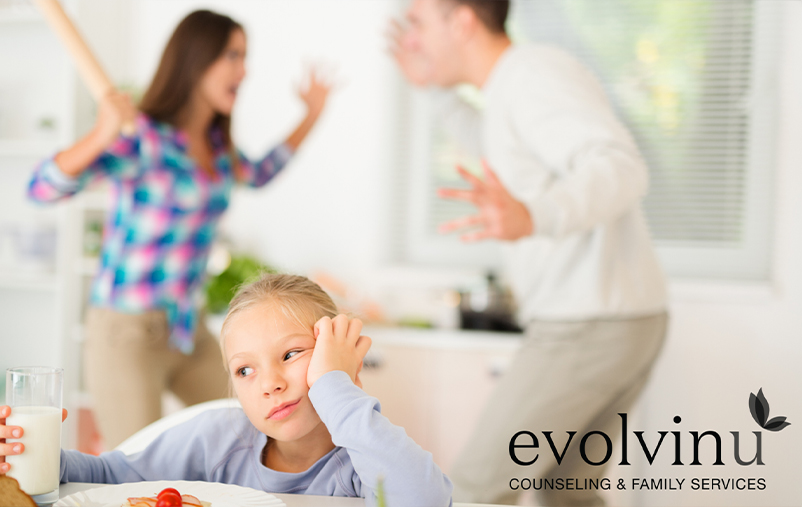
    Sometimes, in families, we often forget that when children are involved or are witnessing continuous conflict in the home, it affects them more than we realize.

     To learn more about the importance of conflict resolution, continue reading below.

     Why Is Conflict Resolution Important In Families?

    Conflict resolution, especially in families, is substantial because it affects the entire family, even if everyone isn’t involved. Unfortunately, the spectating family members, specifically children, can be drastically affected. In addition, ongoing conflicts can cause stress and lead to an unrepairable relationship.

    However, successful conflict resolution reminds adults how to deal with issues effectively and teaches kids how to negotiate and compromise, setting them up for strong relationships throughout life.

     How Does Conflict In Families Affect Children?

    Conflict in the home affects children more than we realize. We may think they are unaware of the events taking place, but kids are very observant and understand when there is tension or arguments.

    Frequent, intense, and unresolved parental conflict can cause children to develop mental health issues and behavioral, social, and academic problems. It can also negatively impact the child’s future.

      Conflict Resolution Tips

    Here are some tips you can remember when resolving a conflict:

    • Try your best to stay calm in the situation.
    • Try to keep your put emotions at bay.
    • Refrain from disrupting the other person when they are speaking.
    • Listen attentively to different perspectives and try to understand what they mean.
    • Ask questions if you need clarification on what they mean.
    • Express your side and viewpoints clearly and honestly.

     Conclusion

    It is ok to get upset or have different perspectives, but how we deal with situations is important. Being mindful of who is being affected or how it’s affecting your relationships can prevent a lot of unnecessary pain and frustration.

    It takes so much energy to hold a grudge and be continuously angry, but it’s much more pleasurable to be happy and have peace of mind. So, let’s resolve the conflicts today.Visit us today at evolvinu.com to learn about us and our therapy services. For an E-book on Communication, click here. It’s time to Embrace your metamorphosis!

  • The Benefits of Couples Therapy

    The Benefits of Couples Therapy

    Couples therapy and counseling are great ways for you and your partner to improve your intimate relationship. So many couples experience challenging times, and nothing is wrong with that. What’s wrong is how they deal with the situation.

    Sometimes, when situations arise, our emotions get the better of us, and we lose sight of each other’s needs and feelings. Unfortunately, if this behavior continues, it can cause a couple to grow apart, leading to unwanted divorces, broken marriages, and families.

    Now, there are many benefits when it comes to couples therapy and counseling. Through therapy, you will realize that sometimes the slightest things can cause significant problems. That’s why it is imperative to understand each other’s triggers and consider them, even when you don’t get along well. You must remember why you fell in love in the first place; therapy can help with that.

    We have listed four essential benefits of couples therapy. For more information, continue reading below. 

    # 1. Gain A Sounding Board.

    The therapist serves as a sounding board to balance both views and perspectives. Having a qualified third party in dealing with relationship challenges will be beneficial. It allows both parties a fair chance to express their concerns and issues without being dismissed by the other.

    Being heard and allowed to speak freely can minimize conflicts in marriages and relationships. When the therapist hears both sides, they can work with them to find a reasonable solution that facilitates everyone and possibly preserve the relationship. 

    #2. Better Understanding Relationship Dynamics.

    Therapists will provide the couple with suitable strategies to boost their dynamics in the relationship. When a couple understands relationship dynamics, they can act around each other in a responsible, respectable, safe, and healthy manner. With this knowledge, couples can maintain a loving atmosphere by practicing what they have learned through therapy.

    As a result, couples become closer with exceptional dynamics, showing support, improving communication, dismissing ongoing resentments, and motivating each other. So, the chances of improving and preserving their relationship are of high expectancy. 

    #3. See Other Perspectives.

    Therapy helps couples to see each other’s perspectives. Being inconsiderate about the viewpoints of others will only exacerbate arguments, leading to further damage to the relationship. This is why it is essential to consider each other’s perspectives.

    Therapists can shed light on factors that affect miscommunication and strongmindedness. They also assist by getting to the root of the problem and providing information to help both parties take each other’s perspectives into account. 

    #4. Learn Coping Mechanisms.

    Even the most stable relationships can be stressful at times. Sometimes, even the most minor things can cause massive problems when a relationship is not at its best. However, knowing how to cope with each other’s issues can improve a relationship.

    Couples therapy helps to introduce healthy coping mechanisms that will benefit both parties. Because everyone deals with stress differently, both parties must find coping mechanisms best suit them.

    Your therapist will explain different coping skills to help you address new issues correctly and maturely before they become more extensive and damaging. 

    Conclusion

    Choosing couples therapy and counseling is the perfect step toward your relationship’s future. It shows that you are ready to heal, forgive, grow, love, and fight for your relationship with the one you chose to be your partner.

    Get ready for new possibilities and adventures with the one you love the most. Don’t wait any longer! Choose couples therapy and counseling today.Visit us today at evolvinu.com/ to learn about us and our therapy services. For an E-book on The Value of Healthy Boundaries in Relationships, click here. Embrace your metamorphosis.

  • Alone in a Relationship: Understanding and Coping with a One-Sided Relationship

    Alone in a Relationship: Understanding and Coping with a One-Sided Relationship

    What is a one-sided relationship?

    One-sided relationships, also known as unrequited love, is love that’s not reciprocated as such by the uninterested or uninvested person. As a result, they may not be aware of the admirer’s deep and pure affection or may consciously reject it for various reasons.

    How does being in a one-sided relationship affect a person?

    Being in a one-sided relationship can be challenging when one person is investing more time, energy, effort, and emotions. The sad reality is that the invested person sacrifices their mental and emotional stability to be with them. They lower their standards and give up their goals to fit into their lifestyle.

    This is because they love that person immensely and think that doing so can make them change. As a result, they keep their hopes up and cannot detach themselves. These types of relationships are unstable because they lack balance and equitable mutuality.

    Signs that you are in a one-sided relationship.

    1. They aren’t there for you when you need them the way you are there for them when they need you. You feel obligated to facilitate all their needs while yours are left on the back burner. If you are unsure, you can analyze how they react when they need something versus when you need something. You’ll know the relationship isn’t mutual if you are mostly met with excuses and negativity when you’re in need.
    2. You do most of the work while the other does little or nothing. A healthy relationship requires commitment, honesty, and healthy connections to thrive. If only one person makes an effort to establish these things and the other doesn’t, it can cause a mental and emotional strain which is unhealthy for the person’s well-being and mental stability.
    1. You feel insecure and like you’re not good enough. You think you must do more to be treated the way you deserve. Yet, despite how hard you try and how much you show them love and respect, you don’t see any changes in their behavior or the relationship. You put your needs aside and question your worth because they make you feel less of a person.
    2. There is more negativity than positivity in the relationship. Your thoughts towards them are mostly negative, but you desperately try to overthrow the negative with a few positive thoughts, if any. You can’t be happy when you’re constantly hoping for the best but expecting the worst.
    3. You try to change or control how they interact with you. But, unfortunately, you can’t alter or force someone to love you or treat you right. It’s up to them if they choose to change, whether for you or themselves. Trying to change someone requires manipulation, which may work, but it won’t be genuine feelings and may cause more harm than good.

    How to fix one-sided relationships?

    Fixing a one-sided relationship has many challenges, but it can become a lot easier when both parties are on the same page. It’ll take a lot of hard work, self-reflection on both sides, honest communication, and therapeutic help if needed. There isn’t a wrong or right way to fix these

    problems. Therefore, they may differ depending on the individuals or the severity of the situation.

    There must be conversations about boundaries and expectations because the views on the relationship may differ. Patience is necessary, as these relationship situations take time to heal and grow.

    When should you end a one-sided relationship?

    Experiencing excessive anxiety, guilt, shame, and resentment can lead to emotional burnout and oscillating feelings of numbness and uncontrollable anger. If you feel like you’ve reached your breaking point, you must do what’s best for your well-being and mental health.

    If your partner is unwilling to hear your needs and concerns or adjust their behavior, that’s a sign that it’s time for you to move on.

    If you have a conversation with them and they respond with defensiveness, play the blame game or gaslight you, then it’s a clear indication that they are unwilling to change or make things work.

    Holding on to the thought of their potential to change when you know within yourself that it may never happen is an unhealthy place to be. It’s time to free yourself and your mind from constant hurt and rejection. You deserve better!

    Conclusion

    All relationships have challenges and personal issues; some are acceptable and tolerable, while others are unacceptable. However, you must remember that you don’t have to settle for anything less and know your worth.

    If fixing the relationship is an option, then both parties must do what needs to be done. After all, it takes two people to encourage structural change, not just one person. No matter how much effort or love you put into it, it won’t work.Visit us today at evolvinu.com to learn about us and our therapy services. For an E-book on Healthy Boundaries, click here. Embrace your metamorphosis.

  • Breaking the Chains: Understanding and Healing from Trauma Bonds

    Breaking the Chains: Understanding and Healing from Trauma Bonds

    Trauma Bonds

    Have you ever experienced a toxic relationship with a parent, romantic partner, or friend? Have you found it difficult to let go of the relationship? These types of relationships are what we call trauma bond relationships. 

    What Is A Trauma Bond?

    A trauma bond is when two or more persons develop a connection rooted in trauma through repeated or continuous cycles of physical, mental, emotional, verbal, or even sexual abuse.

    Trauma bonds display negative characteristics in relationships. Their connection defies logic to others and can be difficult to break, mainly for the abused person(s). 

    What Causes Trauma Bonds?

    Three causes of trauma bonds are:
    • Victims begin to identify with their captors or abusers as a defense mechanism in attempts to prevent further violence. 
    • Acts of kindness from the abuser, no matter how minimal, are amplified by the victim as it reinforces the hope of change that never comes.
    • Oxytocin, “the love hormone,” is a crucial survival bonding hormone released in the brain after pleasant but also painful experiences. It can be so potent that it helps the brain forget or minimize the pain or hurt that came prior. When a mother gives birth to a child, Oxytocin is released, and she forgets the pain of labor and bonds with the baby. We can see here that this hormone has its usefulness. Unfortunately, our brains cannot distinguish between the pain of labor and abuse, which can result in victims bonding with their abuser.

    Types Of Relationships Where Trauma Bonds Can Exist 

    Parent-Child Relationships.

    In parent/child trauma bonds, the child may associate love with abuse. The child may perceive the situation as normal and not see the abusive parent as “bad.”

    The abuse may be verbal, physical, or emotional. Although in some cases, the abuse doesn’t always escalate to physical but remains verbal or emotional. Despite knowing that these bonds are unhealthy, the abused may be unable to break away when they need support from their parents/caregivers. 

    Intimate Partner Relationships

    In intimate partner relationships, the abused form attachments for survival. When their primary source of support is also their abuser, the possibility of forming a trauma bond is high.

    An abused person may turn to their abusive partner for comfort when hurt, hoping to be loved and supported, even though that person was the one who caused it.

    Sometimes the abuser may follow a pattern of abuse, then remorse. They use remorseful behaviors to minimize poor treatment. The smallest kind gestures or words magnifies because they see it as a possibility for change. They know the relationship is toxic, yet they are unable to detach themselves. 

    Friendships

    In friendship trauma bonds, when you have shared many memorable times or you have known them for a very long time, you may ignore the red flags that have always been there.

    They have made you feel paranoid around them, or you must choose your words wisely to prevent escalating an already tense situation. Your differences in opinions/viewpoints will show you whether they continue to respect you in the same way as they do when you agree with them.

    Having to make excuses for their behavior towards you or allowing them to put you in uncomfortable, compromising positions due to fear of them. Wanting to please them or having difficulty exiting those friendships, knowing it’s unhealthy, may be signs that you are in a trauma-bonded friendship. 

    How To Break Trauma Bonds?

    A few ways in which you can break trauma bonds are:
    • Educate yourself on what you’re dealing with.
    • Journal everything you experience and note the abuser’s excuses to learn the pattern.
    • Consider the relationship from a different perspective.
    • Avoid blaming yourself.
    • Stop making excuses for them and see the situation for what it is.
    • Talk to someone or seek therapeutic help.
    • Cut off all contact with them if it is safe to do so.

     Conclusion

    Trauma bonding may be more common than we realize. It can occur in any relationship and affect the abused future relations, challenging maintaining or forming healthy bonds.

    However, there is hope for the future. You can break free and live a happy, healthy, and peaceful life. You can learn to form healthy relationships. Seek the help you need and reward yourself with the life you deserve. 

    Visit us today at evolvinu.com to learn about us and our services. For an E-book on Creating Safety in Your Relationships, click here. Embrace your metamorphosis.

  • Generational Wealth

    Generational Wealth

    As parents, we want nothing but the best for our children. We bend over backward to ensure they live lives easier than our own. Sometimes this requires late nights, broken promises, even missed birthdays. We are saving them from our present circumstances; at least, that’s what we tell ourselves.

    Most people learn that wealth equates to monetary value, such as how many cars, homes, or dollars we have collected. If we struggled and grew up in a one-bedroom unit with our single-mother, we become motivated to have two bedrooms, or even further, three bedrooms. We aim to be detached from our origins as we continually strive for generational wealth.

    It’s human nature to want to leave something behind for the next generation; to give them a head-start. All cultures do it. Some give land and cattle, others priceless heirlooms. Society often influences the search for these possessions. It quickly becomes associated with our self-worth until we become defined by them. Then, not only do we define ourselves by what we have and don’t have, but also by the possessions of others. Sadly, these things can all be taken away from us despite our fight to attain them.

    We live in a world where society teaches us that we have to become rich to be successful. Unfortunately, it leaves out the fact that, in the process, we often become emotionally weak. Wealth is not only in the dollars and cents; it’s also in the relationships we create. We should be teaching our children emotional security, which is even more valuable than leaving behind financial security.

    It may entail refining our focus on nurturing our children so they can know how to regulate their emotions. Making a point to not only show them strengths but also our vulnerability and the process we endured to overcome our weaknesses. Being able to create a safe space where they can disclose their anxiety and fears about the world so that they know they are not alone. All this may seem challenging while working two jobs and trying to make ends meet. Yet the time spent with them is essential, even if it’s to hold them without saying a word. They will learn to treasure the people they love by how we prioritize them. Most important of all, teach them to love themselves for who they are and not what they have.

    Right now, you may be emotionally bankrupt and stuck in the rat race. Still, it’s time to start also investing in your emotional wellbeing. Of course, money is great. It has its place. But there will be rainy days, and on those days when the money is all gone, it will be their character that determines their resilience to start again. Invest today, you and your future generations will reap the rewards.

  • You Are Stronger Than You Think

    You Are Stronger Than You Think

    People often see the strength in others and not themselves. We measure our lives by what we think is the popular social norm. Everyone looks happy on social media; it’s hardly likely that the people you are following are going to reveal their darkest truths online. That’s because everyone wants others to view them as perfect. But the grass isn’t always greener on the other side.

    I’m sure there are things that you’ve lived through that have been extremely hard. It might have been dealing with the chronic illness of a loved one, an abusive relationship, being bullied, getting abandoned, or maybe just never feeling understood. The truth is, you can never live my life, and I can never live yours. You have been coping with the hurdles in your life in various ways though some may not be healthy. Still, the very fact that you’ve made it to today speaks volumes.

    Maybe today is the day that you finally look in the mirror and realize that there is no one in the billions of people on the Earth like you, and that’s pretty special. Only you can live your life to the fullest. Nobody can do it better than you. And despite whatever anyone else might say or how many mistakes you’ve made, you are more than worthy of that happy life you want. Work for it and believe in yourself.

    You shouldn’t measure your life to others because you don’t know what dragons they have to slay at night. What you do know is that no one else can win your fight; only you can.

  • Online Therapy: The Pros and Cons

    Online Therapy: The Pros and Cons

    Against popular belief, research continues to prove that online counseling or e-therapy is as effective as traditional in-person therapy. One of the crucial factors of successful treatment is the therapeutic relationship. Some may think that it is impossible to form a good rapport without seeing the client’s entire body language. However, in this modern age, more friendships and relationships are found online than ever before. The quality of the relationship is more about the authenticity of the people than the medium they are using. Once there is a skilled counselor on one end, and you are willing and open on the other, healing can take place.

    Potential Drawbacks to E-therapy:

    • Secure Location: To maintain the confidential nature of counseling, the best practice would be for you to have a quiet and secure place for your sessions. If you are a parent, it may be challenging to get a room to yourself for an hour, undisturbed. Many clients have sessions in their bedrooms, front porch, or even their cars to get the privacy they need.
    • Reliable Internet Connection: Using a secure video platform is essential to ensure the client’s safety. But even more important is having a strong internet connection on both ends. If you want the best out of your session, make sure that you are close to the modem, or at least where the signal can be steady. Otherwise, your therapist may not hear you, or there will be frequent dropped calls.
    • Crisis: It can be problematic for therapists to intervene in the event of a crisis since they may not be in the same city or even country as you. Therefore, online therapy is not best for people with specific problems or conditions (such as suicidal intent or psychosis).

    Benefits to E-therapy:

    • Avoid the Stigma: We know that seeking mental health treatment is still stigmatized. And as we work to change that stigma, we do not want it to be a hindrance to treatment. Clients no longer have to drive up to a counseling facility or worry about seeing people they know in the waiting room. They can feel secure in knowing that they are seeking their best interest without the intrusive eyes of others.
    • Flexible Scheduling: If there’s an accident on the highway and you miss your in-person therapy appointment, you would most likely still have to pay for it. With online therapy, it is easier to reschedule your appointment if something comes up. To be courteous, try your best to reschedule a day in advance or the morning of your appointment. But life happens! And we understand. Not to mention, if you are working full-time and only have availabilities in the evening or on the weekend. Most private practices would be closed, but online makes it easier to accommodate.
    • Economically Friendly: We often don’t count the cost it takes to drive to and from our appointments. But the truth is, that gas money adds up! There is already a fee-for-service with your counselor; why pay even more for transportation? Gone are the days where you have to commute an hour to seek the help you need.
    • More Professional Options: Traditional therapy is helpful to those who use it. However, if you want in-person, it limits the number of therapists you have access to choose from. However, if you try the online route, it opens your scope of who you can select to be your provider, and there is an entire world out there.
    • Breaking Barriers: With traditional therapy, all clients would have to be in the same country, same city, same office, at the same time. If you have family members that travel or a long-distance relationship, this may not always be the case. However, e-therapy can allow persons who are in different locations to engage in the counseling process without hindrances.
    • Talking to a Stranger: For many people, one of the biggest hindrances to starting counseling is talking to a stranger. Individuals who experience anxiety, especially social anxiety, are more comfortable reaching out to an online therapist. It can be simpler for some people to reveal private information when they’re sharing it online as opposed to in-person.

    E-therapy is making mental health more accessible and convenient for the wider population. Still, it is imperative to be sure that your online therapist is a licensed or certified mental health treatment provider.